
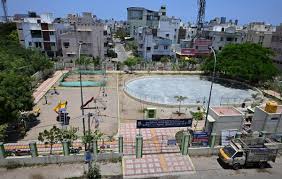
 Rapid urbanization in Chennai has led to a significant reduction in playground spaces, sparking concerns among parents, educators, and urban planners about its impact on children’s physical and mental health. The city’s relentless expansion, coupled with increasing infrastructure projects, has left fewer open spaces for recreational activities.
According to a recent survey, Chennai has witnessed a 40% reduction in open spaces over the last decade. The remaining parks and playgrounds are either overcrowded or poorly maintained. As a result, children are increasingly confined to indoor activities, missing out on essential physical exercise and social interaction.
“Chennai’s development seems to be coming at the cost of our children’s future,” says Rajiv Menon, a social activist working for urban sustainability. “Playgrounds are not just for recreation; they are vital for a child’s holistic growth. Yet, they are vanishing before our eyes.”
Parents, too, are feeling the pinch. Rekha Subramanian, a mother of two, shares her frustration: “My kids used to play cricket in a nearby ground, but now it’s turned into a parking lot. It’s heartbreaking to see them glued to screens because there’s no safe space for them to play.”
Health experts warn that the lack of physical activity could lead to long-term consequences for children. “The absence of playgrounds has contributed to rising obesity levels and mental health issues among urban children,” says Dr. Priya Narayan, a pediatrician in Chennai. “Outdoor play is essential for building immunity, motor skills, and social behavior.”
Urban planners point out the lack of foresight in city planning. “Chennai’s master plans rarely prioritize open spaces. If we don’t integrate playgrounds into future projects, our children will pay the price,” says urban planner S. Chandrasekar.
Many believe that policy-level changes are the need of the hour. “The government must ensure that every neighborhood has accessible and well-maintained play areas,” says Shalini Ramesh, an architect focused on sustainable urban design.
Community-driven initiatives also offer hope. In areas like Anna Nagar, residents have reclaimed vacant plots to create makeshift playgrounds. “If authorities won’t act, it’s up to us to find solutions,” says Rajesh Kumar, a resident leading such an effort.
As Chennai continues to grow, preserving spaces for children’s play must become a priority. Without immediate action, the city risks raising a generation deprived of outdoor joys and the vital benefits they bring. As Dr. Priya puts it, “A city without playgrounds is a city without a childhood.”
