
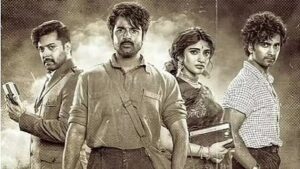
A tribute to language
Parasakthi stands tall as a bold and emotionally charged political drama that resonates long after the final frame. Produced by Aakash Baskaran, the film is set against the volatile canvas of the 1960s student uprisings in Tamil Nadu and pulsates with linguistic pride, youthful idealism and the unyielding spirit of resistance. Director Sudha Kongara handles this sensitive chapter of history with remarkable clarity and courage, blending politics and personal emotion into a deeply engaging narrative.
At the heart of the film is Sivakarthikeyan, delivering arguably the finest performance of his career. As Chezhiyan, a passionate student revolutionary turned restrained family man, he brings layered intensity and quiet heartbreak to the role. His transition from a fiery leader to a man weighed down by memory and responsibility is portrayed with striking restraint. The opening sequences crackle with energy, vividly capturing the charged atmosphere of campus politics and the rise of the revolutionary student collective Purananooru.
The narrative smartly shifts five years ahead, introducing a sharp ideological contrast through Atharvaa, whose unyielding rebel spirit reignites the film’s core conflict. Atharvaa delivers a powerful and convincing performance.
Sri Leela, as a Telugu-speaking ally to the movement, adds warmth and emotional depth, reinforcing the film’s inclusive message—that linguistic pride need not turn into linguistic hostility. Her character becomes increasingly impactful as the story builds towards a stirring climax.
The pre-interval portion is tightly packed and leads to a hard-hitting turning point, while the second half unfolds as a gripping cat-and-mouse game. Ravi Mohan is menacing and authoritative as the antagonist, his sharp dialogue delivery adding weight to the ideological battle at the centre of the film.
Technically, Parasakthi is impressive. GV Prakash Kumar’s rousing background score elevates the emotional and political moments, while Ravi K Chandran’s cinematography and the detailed production design authentically recreate the 1960s milieu.
Though the screenplay could have been tighter in parts, Sudha Kongara’s bold vision ensures the film never loses its impact.
Overall, Parasakthi is a rebellious, emotional and thought-provoking cinematic experience—powered by strong performances, solid technical finesse and a sincere tribute to student movements and linguistic identity.
