
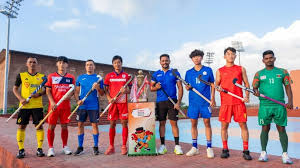
 Rajgir, Sept 9: The gamble of letting go some seasoned campaigners to blood youngsters paid off quite well for the Indian hockey team in a triumphant Asia Cup campaign, setting the stage for some more churning ahead of next year’s World Cup and the Asian Games.
Three players from the Paris Olympics bronze medal-winning side — Shamsher Singh, Gurjant Singh and Nilakanta Sharma — were dropped in favour of mid-fielder Rajinder Singh and striker Shilanand Lakra.
The move turned out to be a masterstroke as both the youngsters, despite managing just a goal each, impressed in the just-concluded tournament in which India defeated Korea in the finals to win the title after eight years and be assured of a World Cup spot.
And going forward one can expect some more reshuffle in India’s core group, especially after the FIH Junior World Cup to be held in Chennai and Madurai from November 28 till December 10.
Keeping the World Cup (to be jointly hosted by Belgium and the Netherlands from August 14 to 30) and the Asian Games (from September 19 in Japan) in view, India are expected to test some promising juniors at the senior level after the Junior World Cup.
Hockey India’s chairman of selectors RP Singh has already made it clear that some under-performing seniors will be phased out slowly.
He emphasised that performance and fitness are the only criterion for representing the national team.
“There are a few players who are under the scanner and we will assess their performances after the Asia Cup. We need to see upcoming players while making our team now. At one go if we sent six-seven senior players out of the team, it won’t work,” Singh said.
“It is the responsibility of the selection committee to ensure the senior players who are not performing are phased out slowly.” India have a packed schedule from October to December, during which they will compete in the Sultan Azlan Shah Cup in Malaysia before embarking on a Test tour of South Africa, and head coach Craig Fulton is expected to test a few juniors in these tournaments.
The Asia Cup crown also came as a soothing balm for the Harmanpreet Singh-led side, especially after its disappointing outing in the European leg of the FIH Pro League.
Overcoming a slow start, the team stamped its authority in the continental showpiece, winning it for a fourth time overall here.
They last won the trophy in 2017 in Dhaka and their previous two triumphs came in 2003 in Kuala Lumpur and 2007 in Chennai.
India might have finished strong but the start was far from rosy as the hosts had to dig deep to eke out 4-3 and 3-2 wins over China and Korea in the pool stages.
Their campaign gained momentum after a 15-0 thrashing of lowly Kazakhstan.
“We did not have the best of starts and the players knew that. We gained momentum after the Kazakhstan match. The players felt more confident after that big win,” Fulton had said.
But the 2-2 draw against Korea in the Super 4 stage again gave India a reality check.
However, the hosts lifted their game by a few notches to thrash Malaysia 4-1 and then China 7-0 before the emphatic win over Korea in the final.
One heartening aspect of the campaign was the fitness of Indian players.
