
New Delhi, April 17:
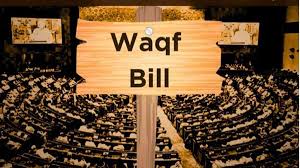
The Central Government has informed the Supreme Court that it will refrain from making any new Waqf board appointments or altering the status of properties claimed by Waqf boards, until the next hearing of petitions challenging the recent amendments to Waqf laws.
This assurance came during the court’s hearing on a series of petitions filed against the changes made to the laws governing the administration of Muslim charitable properties, including the contentious ‘waqf by user’ provision. This provision allows properties used by Muslims for religious or charitable purposes—despite lacking formal documentation—to be claimed as Waqf properties.
“We are not saying all ‘waqf by user’ claims are wrong… but there is concern,” the court observed, highlighting potential misuse of this clause.
The court was also informed that existing waqf properties would retain their current status and that the government would not make appointments under Sections 9 and 14 of the amended law. These sections have drawn criticism for limiting Muslim representation in the Central Waqf Council and state Waqf boards to eight and four members respectively, out of a total of 22 and 11.
A particularly debated change has been the mandate to include non-Muslims in the Waqf boards—a move that has triggered widespread protests and opposition across the country. The state of West Bengal witnessed violent demonstrations, resulting in the death of three people. This sparked a political row between the ruling Trinamool Congress and the BJP, with the former refusing to implement the amended law and the latter accusing the state of appeasement politics.
Chief Justice Sanjiv Khanna questioned the logic behind the amendments, asking, “Will Muslims be allowed on Hindu endowment boards in turn? Say it openly,” in a sharp exchange with Solicitor General Tushar Mehta, who appeared for the Centre.
The Supreme Court clarified that it would focus on five key writ petitions and dispose of the remaining hundreds that have been filed on the same issue. The government has been granted a week to submit its response to the challenges, after which the petitioners will have five days to reply.
In an earlier hearing, the court had considered issuing an interim stay on the revised provisions to ease growing unrest, but held back after both the Centre and several states requested more time.
The three core concerns under review are:
Whether court-declared waqf properties under ‘waqf by user’ can now be deemed void;
The inclusion of non-Muslims as a majority in Waqf boards;
Whether properties currently under dispute and pending inquiry can be treated as waqf.
While the court reiterated its commitment to not encroach upon the legislature’s domain, it also acknowledged its duty as the constitutional guardian to examine laws that could potentially infringe on fundamental rights—such as equality and freedom of religion.
The amendments have been challenged by various opposition leaders, including those from the Congress, AAP, DMK, CPI, and even JDU—a BJP ally—indicating deep and wide-ranging concerns over the new Waqf regulations.
