
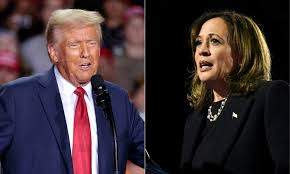
In a historic election, Donald Trump has reclaimed the presidency, defeating Kamala Harris in what turned out to be a decisive victory. Despite the expectation of a close race, Trump captured several key swing states, solidifying his win and marking a major political comeback. As the dust settles, questions emerge over why Kamala Harris, despite her rising profile, lagged behind in capturing the electorate’s confidence.
Challenges from the Biden Administration’s Legacy
As the incumbent vice president, Kamala Harris’s campaign was heavily tied to President Joe Biden’s record—a record that faced mounting criticism over his handling of key issues. From inflation and unemployment to international tensions, Biden’s administration struggled with a low approval rating. Ongoing international conflicts, particularly the Israel-Hamas war and the Russia-Ukraine standoff, cast a shadow on Biden’s foreign policy approach, raising concerns over his administration’s global strategies and leading some to see him as politically weakened in comparison to Trump.
In response, Trump made economic stability a focal point of his campaign. Referring frequently to his previous term, he highlighted lower inflation and unemployment, asserting that his administration fostered both economic prosperity and a stronger global standing. This narrative framed him as the more stable candidate, a point his campaign drove home by directly contrasting his record with Biden’s current challenges.
Biden’s Late Withdrawal and Harris’s Race Against Time
With President Biden’s sudden exit from the race three months before the election, Kamala Harris found herself thrust into the position of successor, with little time to mount a robust campaign. Biden’s decision left the Democratic Party scrambling for stability and forced Harris to refocus her platform with limited preparation. Trump, despite facing legal controversies, enjoyed solid support within the Republican Party, which provided his campaign with a steadier foundation from which to challenge Harris.
Fallout from Biden’s “Trash” Remark
Mid-campaign, Biden referred to Trump supporters as “trash,” a comment that backfired. Harris quickly attempted to distance herself from the remark, but Trump capitalized on the controversy, using it to galvanize his base and emphasize national pride. The fallout from Biden’s remark only served to strengthen Trump’s standing among voters who felt alienated by the administration’s language.
Immigration as a Key Dividing Line
Throughout his campaign, Trump focused heavily on immigration, pledging to deport a million undocumented immigrants and secure the U.S.-Mexico border. This stance resonated particularly with white working-class voters who viewed the Biden administration’s immigration policies as overly permissive. Harris, though vocal on women’s rights and social justice, found it difficult to counter Trump’s immigration message. Her liberal position struggled to gain traction in the face of the hardline approach Trump promised.
Reflecting on Harris’s Loss
Kamala Harris entered the race with high expectations, bolstered by a visible profile and strong debate performances. However, her alignment with Biden’s administration, coupled with the sudden reshuffling after Biden’s exit, made it challenging for her to fully define her own campaign narrative. Trump’s positioning as a stabilizing force with a proven track record resonated with voters dissatisfied with the current administration, ultimately paving his way back to the White House.
As the U.S. enters a new chapter with Trump’s return, the 2024 election serves as a profound reminder of the influence of public perception on past records, and the weight of a president’s legacy on those who follow.
