
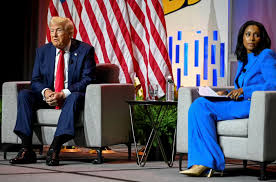
 Washington, August 2: Former President Donald Trump has ignited controversy with his recent comments about Vice President Kamala Harris. Speaking at a National Association of Black Journalists (NABJ) event in Chicago, Trump claimed that Harris, who is biracial with an Indian mother and a Black father, was “always Indian” but “turned Black” at some point. His remarks have been widely criticized as divisive and disrespectful.
Trump made these statements in response to a question about Harris’s identity. When asked if he thought Harris was a “DEI candidate” — referring to diversity, equity, and inclusion — Trump first asked for clarification and then suggested that Harris had recently changed her racial identity. “I didn’t know she was Black until a number of years ago when she happened to turn Black,” Trump said. “Now she wants to be known as Black.”
Harris, who has consistently embraced both her Indian and Black heritage, dismissed Trump’s comments as part of a broader pattern of divisiveness. The White House called Trump’s remarks “repulsive,” and Gregory Meeks, a Democratic leader, labeled them as “extremely offensive” to Black communities. Derrick Johnson of the NAACP also condemned Trump’s statements, highlighting the disrespect towards Harris and the Black journalists present.
Trump’s comments have been seen as an attempt to drive a wedge between Harris and the Black community. His campaign has continued to use this narrative, posting videos and statements that misrepresent Harris’s celebration of her heritage.
Harris, who was raised in the Black community and has written about her dual identity in her memoir, responded to the criticism by emphasizing the importance of respect and truth in leadership. She rejected Trump’s attempts to question her identity and reiterated her commitment to representing both aspects of her heritage.
Trump’s remarks have sparked a renewed discussion about racial identity and the respect owed to individuals, regardless of their heritage.
