
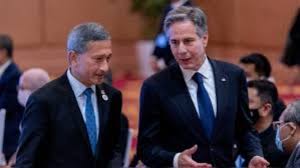
 Singapore, Aug 1: In a significant move towards enhancing their energy collaboration, the United States and Singapore have signed a civil nuclear cooperation agreement on Wednesday. This pact marks a critical step for Singapore as it seeks to diversify its energy sources and achieve net-zero carbon emissions by 2050.
US Secretary of State Antony Blinken and Singaporean Foreign Minister Vivian Balakrishnan formalized the “123 Agreement” during Blinken’s visit to Asia. The agreement, named after its section in the US Atomic Energy Act, is essential for facilitating investments by US nuclear firms by ensuring compliance with nonproliferation laws.
The agreement establishes a comprehensive framework to expand peaceful nuclear cooperation between the two nations, emphasizing a shared commitment to nuclear nonproliferation. It will provide Singapore with access to detailed information on advanced US nuclear technologies, including small modular reactors, which promise improved safety and economic benefits over traditional nuclear power plants.
“This agreement builds on our long-standing partnership in civil nuclear technology and strengthens our mutual commitment to peaceful nuclear use and nonproliferation,” said the joint statement released by both governments.
The pact, which is set to come into force by the end of 2024 pending review by the US Congress, is designed to last for 30 years. It will also integrate Singapore into a US Department of State program focused on advanced nuclear technologies, potentially transforming the city-state’s energy landscape.
Singapore, a leading financial hub and a major player in the semiconductor industry, currently relies heavily on oil and natural gas. As part of its strategy to meet its climate goals, Singapore is exploring various energy alternatives, including nuclear power.
The signing of this agreement reflects the broader trend of the US expanding its nuclear cooperation globally. Washington currently has active “123 Agreements” with 22 countries and several international organizations, including the European Atomic Energy Community and the International Atomic Energy Agency.
The agreement is expected to bolster Singapore’s efforts to modernize its energy infrastructure while reinforcing the strategic energy ties between the US and Singapore.
