
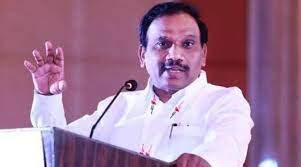
 Chennai, Nov 13: DMK leader and former union minister A Raja, against whom a writ of quo warranto was filed for his speech on Sanatana Dharma, in a counter affidavit said the allegations that were made were vague.
The views and opinions were his own and were not unconstitutional in any manner, he argued, noting it was his duty as a public servant to criticize and condemn “illegal practices”. A Raja said as long as, what he termed was ‘illegal practices’, the inequality on the basis of caste and gender, are still being continued and practised in the name of Sanatana Dharma — in the society were continued and until put to an end, it was his duty as a public servant to criticize and condemn as a duty towards the nation.
“…whatever I spoke about Sanatana Dharma were my views and opinions, which I am entitled to express, as the Constitution guarantees freedom of conscience to everyone, including me,” Raja, who has been a Member of Parliament for more than 20 years, said in the counter affidavit dated November 6 to the Madras High Court. “I deny all the factual averments and allegations contained in the Affidavit filed in support of the Writ Petition as false, frivolous, distorted and taken out of context…,” Raja said.
He submitted before the Court that the Writ Petition seeking issuance for a Writ of Quo Warranto against an elected Member of Parliament is not maintainable under the Constitution of India before this Court “in the facts and circumstances of the present case”. A writ of quo warranto is a common law remedy that is used to challenge a person’s right to hold a public or corporate office. Further making his cases, the writ petition filed against him was “liable to be dismissed with cost.”
He submitted before the Court about the Constituent Assembly which had deliberated upon the Sanatana Dharma and related issues when the Hindu Code Bill was introduced and debated in the year 1949.
“The arguments advanced on both sides in support of and against these issues in the Constituent Assembly, the reply given by the then law minster, Dr. B.R. Ambedkar, and the consequential assurance given by the then Prime Minster Pandit Jawaharlal Nehru, to enact the Hindu Code Bill actually resulted in the statutory enactments of the Hindu marriage Act, 1955, Hindu Succession Act 1956, and Hindu Adoption and Maintenance Act 1956.
This is a significant aspect which must be taken note of while deciding the maintainability of this Writ Petition as per the provisions of the Constitution of India,” Raja’s counter-affidavit read.
In a meeting in early September, Raja reportedly said Sanatana Dharma was like the human immunodeficiency virus (HIV) that needed to be destroyed. In the meeting in Udhagamandalam on September 7, Raja said that people in North India had become aware of the need to defeat Hindutva forces, and were looking towards the DMK and Dravidian parties for “the cure.”
“Everyone is ready to kill the poisonous snake, but nobody has the cure to the bite from the snake, except Periyar, Anna, and the DMK,” Raja had said. He also supported Minister for Youth Welfare and Sports Development, Udhayanidhi Stalin’s remarks comparing Sanatana Dharma with dengue and malaria, which mutated into a political slugfest between the BJP and the DMK.
