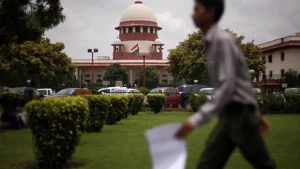
 The Supreme Court said on Wednesday it is aware of the “Lakshman Rekha” on judicial review of government policy decisions but will have to examine the 2016 demonetisation decision to decide whether the issue has become a mere “academic” exercise.A five-judge bench headed by Justice S A Nazeer said when an issue arises before a constitution bench, it is its duty to answer.Attorney General R Venkataramani submitted that unless the Act on demonetisation is challenged in a proper perspective, the issue will essentially remain academic.The High Denomination Bank Notes (Demonetisation) Act was passed in 1978 to provide in public interest for demonetisation of certain high denomination bank notes in order to check illicit transfer of money harmful to the economy which such currency notes facilitate.The top court said in order to declare whether the exercise is academic or infructuous, it needs to examine the matter since both sides are not agreeable.”In order to answer that issue, we will have to hear and give an answer whether it’s academic, not academic or beyond the scope of judicial review. The point in the case is the government policy and its wisdom which is one aspect of the matter.”We always know where the Lakshman Rekha is, but the manner in which it was done has to be examined. We have to hear the counsel to decide that,” the bench, also comprising Justices B R Gavai, A S Bopanna, V Ramasubramanian, and B V Nagarathna said.Solicitor General Tushar Mehta, appearing for the Centre, said the court’s time should not be “wasted” on academic issues.Objecting to Mehta’s submission, senior lawyer Shyam Divan, representing petitioner Vivek Narayan Sharma, said he was surprised at the words “waste of constitutional bench’s time” as the earlier bench had said these cases must be placed before a constitution bench.Senior advocate P Chidambaram, appearing for one of the parties, said the issue has not become academic and it has to be decided by the top court.

News Today | First with the news
News Today | First with the news
