
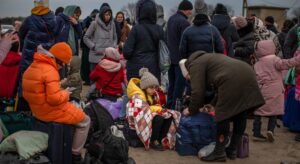
 New York : The quick acceptance of Ukrainians fleeing Russia’s aggression puts a spotlight on Europe’s double standard for migrants, standing against its non welcome for people fleeing violence in Africa, the Mideast and elsewhere, the head of the world’s largest humanitarian network said Monday.
Francesco Rocca, president of the International Federation of Red Cross and Red Crescent Societies, said he doesn’t think there is any difference’ between someone fleeing eastern Ukraine’s Donbas region and someone escaping the Boko Haram extremist group in Nigeria.
Those who are fleeing violence, those who are seeking protection, should be treated equally, said Rocca, whose organisation operates in more than 192 countries with almost 15 million volunteers. Speaking at a news conference, he said there is a moral imperative to help people escaping violence and upheavals, and the political, public and humanitarian response to the Ukraine crisis has shown what is possible when humanity and dignity comes first, when there is global solidarity.
We hoped that the Ukrainian crisis would have been a turning point in the European migration policies, Rocca said. But unfortunately, this was not the case. He said the 27-member European Union still has different approaches to migration at its eastern border from Ukraine and its southern border on the Mediterranean. The war, which Russia insists on calling a special military operation, has prompted one of the worst humanitarian crises in Europe since World War II.
Since Russia invaded on February 24, more than 6 million people have fled Ukraine, with Poland absorbing more than 3.3 million and over 900,000 going to Romania, 605,000 to Hungary, 463,000 to Moldova and, 421,000 to Slovakia, according to the UN refugee agency. By contrast, Rocca said, migrants, refugees and asylum seekers trying to get to Europe are still dying, facing abuse and struggling to access essential services. Over 48,000 migrants have died or disappeared since 2014 while travelling at sea, and the deadliest route is that taken by migrants across the central Mediterranean to Europe, with at least 19,000 such deaths, he said. Those who arrive, mainly in Italy, Greece and Spain, are often put in camps and face long waits for their asylum claims to be heard.
