
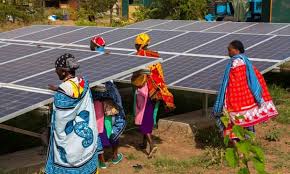
 Nairobi, July 27 A new report by FSD Africa and Shortlist forecasts that Africa could generate 3.3 million jobs by 2030 through a transition to a greener economy. The “Forecasting Green Jobs in Africa” study highlights that the renewable energy sector will play a pivotal role, accounting for approximately 70% of the new employment opportunities.
The report focuses on five key countries — the Democratic Republic of the Congo (DRC), Ethiopia, Kenya, Nigeria, and South Africa — which are expected to see significant job growth from green industries. It predicts that 60% of these roles will be skilled or white-collar positions, potentially bolstering the middle class in high-growth sectors such as renewable energy, e-mobility, and climate-smart agriculture.
According to the study, around 10% of the new jobs will require university degrees, 30% will demand specialized certification or vocational training, and 20% will be administrative roles. The remaining jobs will provide stability and opportunities for upward mobility, particularly in unskilled labor.
Paul Breloff, CEO of Shortlist, emphasized the importance of human capital in driving green economic growth, noting that the report is the first to seriously consider the role of talent in this transition. “This report highlights the need for investment in training and education to prepare a workforce for the industries of the future,” he said.
The renewable energy sector, particularly solar power, is expected to create approximately 1.7 million jobs. Countries like DRC and Ethiopia, with substantial hydropower potential, are poised to benefit significantly. Agriculture is also set to employ hundreds of thousands in climate-smart technologies.
The report calls for policymakers, funders, and educational institutions to invest in workforce development to capitalize on these opportunities. It argues that supportive policies and significant financial investments — estimated at over $100 billion annually — are crucial for Africa to leapfrog traditional carbon-intensive development pathways.
Despite the promising outlook, Africa currently attracts only 3% of global clean energy funding. The report warns that to meet climate and energy access goals, investments need to more than double by 2030, according to the International Energy Agency and the African Development Bank.
Kevin Munjal, Director of Development Impact at FSD Africa, stressed that developing a skilled workforce is essential for de-risking investments and attracting funding. “Green growth offers a significant opportunity to address Africa’s demographic challenges and create economic opportunities for its young population,” Munjal said.
As Africa’s renewable energy sector develops, it has the potential to drive both job creation and economic growth, helping to address the continent’s pressing need for employment and sustainable development.
