
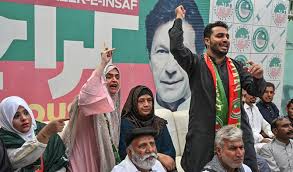
 Islamabad, July 13: Pakistan’s Supreme Court has granted a significant legal victory to the Pakistan Tehreek-e-Insaf (PTI) party of former Prime Minister Imran Khan. In an 8-5 ruling by a 13-member bench, the court declared PTI eligible to receive its share of reserved seats in national and provincial assemblies, marking a major setback for the coalition government.
The case was initiated by the Sunni Ittehad Council (SIC), which PTI-backed candidates joined after the February 8 general election. These candidates were forced to run as independents due to electoral law violations that led the Election Commission of Pakistan (ECP) to bar PTI from using its electoral symbol, a cricket bat.
Despite these challenges, PTI candidates secured 93 seats in the National Assembly, surpassing other parties. The Pakistan Muslim League-Nawaz (PMLN) came second with 75 seats, followed by the Pakistan People’s Party (PPP) with 54 seats. The PMLN and PPP then formed a coalition government with smaller parties.
Pakistani law stipulates that 266 National Assembly seats are filled through general elections, with an additional 70 reserved seats (60 for women and 10 for minorities) distributed based on election performance. A simple majority of 169 seats is required to form a government, with a two-thirds majority of 224 votes necessary for constitutional amendments.
The Supreme Court’s verdict emphasized that the lack of an election symbol did not impact PTI’s legal right to field candidates. The court instructed PTI to submit its list of names for reserved seats within two weeks, and PTI-backed SIC candidates in the assembly to declare their political affiliation within the same timeframe.
Currently, SIC holds 86 seats in the National Assembly, with four PTI-backed candidates choosing to remain independents. It is anticipated that PTI will receive over 20 reserved seats in the national legislature following this ruling.
PTI leader Gohar Ali Khan celebrated the Supreme Court’s decision, labeling it a victory for the rule of law and democracy in Pakistan.
“This decision will be remembered in history. It’s a win for Pakistan’s democracy and restores our party’s rights,” Khan stated.
Constitutional lawyer Rida Hosain supported the ruling, criticizing the ECP for its conduct and questioning its impartiality.
“The order criticizes the ECP for its conduct, which has been detrimental to Pakistan’s democratic process. The electoral watchdog has a constitutional duty to be independent and impartial, yet it acted against a major political party, unlawfully denying PTI its right to contest elections,” Hosain commented.
Electoral law specialist Akram Khurram also criticized the ECP, noting that the judges unanimously questioned the decision to bar PTI from using its symbol during elections.
“Every judge on the bench concluded that the ECP misinterpreted the Supreme Court’s verdict on PTI’s electoral symbol. The election body must take responsibility for the political crisis and legal complications arising from its decision,” Khurram said.
Despite denying any bias, Election Commission officials have faced significant criticism.
Political analyst Benazir Shah highlighted the impact of the verdict on parliament’s composition and credibility.
“If PTI had lost the reserved seats, it would have further damaged parliament’s credibility. Now, with reserved seats allocated to the PTI, it becomes the largest political party in parliament,” Shah explained, suggesting a potential shift in coalition dynamics.
Shah pointed out that although the current government holds a clear majority, the PPP might consider aligning with PTI, leaving the coalition with PMLN.
Majid Nizami, a Lahore-based political commentator, described the decision as a “sigh of relief and a ray of hope” for PTI, which has faced political challenges since its government was ousted in April 2022 by a parliamentary vote of no confidence.
Nizami noted that while the numerical balance in assemblies may not change significantly, the court decision will impact the legislative process.
“The government will no longer have a two-thirds majority in the assembly. This means any constitutional amendments and laws they planned to present cannot pass smoothly without PTI’s support,” Nizami concluded.
