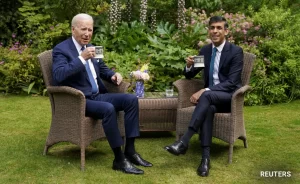
 U.S. President Joe Biden touted a “rock solid” friendship with Washington’s closest ally Britain on Monday, dropping in at Prime Minister Rishi Sunak’s office in London for talks en route to a NATO summit planned to show Western resolve over Ukraine. Biden landed in London late on Sunday to kick off a three-nation trip including the NATO summit in Lithuania, at which allies aim to show solidarity with Ukraine against Russia’s invasion while not yet accepting Kyiv as an alliance member. Both sides played down the president’s meeting with Sunak, their fifth in as many months, describing it as a continuation of long-running discussions, though it was Biden’s first visit to the British prime minister’s Downing Street office as president. Biden is also due to meet King Charles later on Monday, after skipping his coronation in May in line with the longstanding practice of U.S. presidents. They are expected to discuss climate change, a cause the monarch has long embraced. “Great for us to carry on our conversations,” Sunak told Biden as they sat in the Downing Street garden. “We’ve got a lot to talk about,” Biden replied. “Our relationship is rock solid.” White House national security adviser Jake Sullivan said the two leaders would share notes before the NATO summit in Lithuania, which kicks off on Tuesday and will be dominated by the Ukraine crisis. Ahead of the trip, Biden urged caution for now on Ukraine’s campaign to join NATO, saying the alliance could get drawn into the war with Russia due to NATO’s mutual defense pact. “I don’t think there is unanimity in NATO about whether or not to bring Ukraine into the NATO family now, at this moment, in the middle of a war,” Biden said in a CNN interview that aired Sunday. Biden’s trip comes a few days after he agreed to send U.S. cluster munitions to Ukraine. Such munitions are banned by more than 100 countries, including the United Kingdom, viewed as a threat to civilian populations because they typically release large numbers of smaller bomblets that can kill indiscriminately over a wide area. Russia, Ukraine and the United States have not signed on to the Convention on Cluster Munitions, which bans production, stockpiling, use and transfer of the weapons.

News Today | First with the news
News Today | First with the news
