
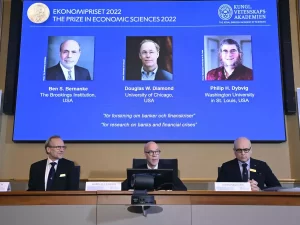
 This year’s Nobel Prize in economic sciences has been awarded to the former chair of the U.S. Federal Reserve, Ben S. Bernanke, and two U.S.-based economists, Douglas W. Diamond and Philip H. Dybvig, “for research on banks and financial crises.”The prize was announced Monday by the Nobel panel at the Royal Swedish Academy of Sciences in Stockholm.
The committee said their work had shown in their research “why avoiding bank collapses is vital.”With their research in the early 1980s, the laureates laid the foundations for regulating financial markets and dealing with financial crises, the panel said.Bernanke, 68, who is now with The Brookings Institution in Washington, D.C., examined the Great Depression of the 1930s, showing how dangerous bank runs — when panicked savers withdraw their deposits — can be.Diamond, 68, based at the University of Chicago, and Dybvig, 67, who is at Washington University in St. Louis, showed how government guarantees on deposits can prevent a spiraling of financial crises.“The laureates’ insights have improved our ability to avoid both serious crises and expensive bailouts,” said Tore Ellingsen, chair of the Committee for the Prize in Economic Sciences.Their research took on great real-world significance when investors sent the financial system into a panic during the fall of 2008.Bernanke, then head of the Fed, teamed up with the Treasury Department to prop up major banks and ease a shortage of credit, the lifeblood of the economy.He slashed short-term interest rates to zero, directed the Fed’s purchases of Treasury and mortgage investments and set up unprecedented lending programs. Collectively, those steps calmed investors and fortified big banks.They also pushed long-term interest rates to historic lows and led to fierce criticism of Bernanke, particularly from some 2012 Republican presidential candidates, that the Fed was hurting the value of the dollar and running the risk of igniting inflation later.The Fed’s actions under Bernanke extended the authority of the central bank into unprecedented territory. They weren’t able to prevent the longest and most painful recession since the 1930s. But in hindsight, the Fed’s moves were credited with rescuing the banking system and avoiding another depression.Nobel prizes carry a cash award of 10 million Swedish kronor (nearly $900,000) and will be handed out on Dec. 10.
